Showing posts with label Soteriology. Show all posts

Wednesday, March 9, 2016

Deliverer

Jesus didn’t die for America.
Jesus didn’t die for England.
Jesus didn’t die for Rome
Jesus didn’t die for empires.

Jesus died to free the black man in prison.
Jesus died for the refugee.
Jesus died for the cop who no longer wants to oppress.
Jesus died for the soldier who doesn’t want to kill.

Jesus died for those trapped in a system of oppression
Jesus died to deliver us from empires.

Sunday, March 6, 2016

Became Sin

Jesus didn’t become adultery for us
Jesus didn’t become an axe murderer
Nor a pedophile, nor even a thief.

Jesus became the object of scorn,
The innocent oppressed.
He became the sin of the black man killed by the police.
He became the sin of the single mother on welfare.
He became the sin of the child beaten to half-death.
He became the sin of the homeless
  The sin of the Muslim
  The sin of the poor.

Which is no sin at all
Except in the mind of the oppressor.


Wednesday, March 2, 2016

Abuse

The idea that we are born in sin
And so must be punished
Is the theology of the abused child
Convinced that they deserve their regular beatings.


Jesus never claims a human is born in sin.
Rather, he strives to convince us
And all those around us
That we are going to be the focus
Of God’s unbelievable miracle. 

Friday, January 22, 2016

Why did Jesus die?

Jesus didn't die to save us from breaking a petty law. Rather, he died to give us an option to live, apart from the "oppress or be oppressed" world we live in. He died to open up a new world-- a world of generosity, of mercy, where forgiveness actually works. He died to get rid of petty laws and vengeances, and replace them with lives of love and grace.
Most of all, he died to show us that we can give into oppression and win in the end. That surrender to death isn't the end of the story. Allowing an oppressor to step on us isn't what we should fear. Our greatest fear should be being forced to be hard-hearted and judgmental.

Thursday, June 25, 2015

Salvation is...

What is Salvation?


The salvation of the Father is…
…living with God
…a homeland of peace and security and justice
…sufficient food and drink and warmth for everyone
…deliverance from enemies and all who hate us
…a family and a community that cares for you and supports you
…the ability to worship and serve God in how he desires us to
…living obediently to God, free from sin and rebellion
…life and peace that lasts forever

The salvation of Jesus is…
…freedom from slavery to sin
…freedom from the consequences of sin, including suffering, hatred and death.
…being made right with God
…remaining satisfied with who you are without anxiety, shame or fear.
…being reconciled to your community
…being raised from the dead
…being a peacemaker, drawing others closer to God and to others

The salvation of the Holy Spirit is…
…always having the ability to do what is right
…living in love of others
…having wisdom to know and do what God wants
…understanding what is true and right
…courage to stand for God in all circumstances, no matter the cost


Your Salvation is Too Small:
If your salvation includes forgiveness, but not healing, then your salvation is too small.
If your salvation includes heaven, but not a restored earth, then your salvation is too small.
If your salvation includes Christians, but not sinners, then your salvation is too small.
If your salvation includes freedom of worship, but not food, shelter and hope for the poor, then your salvation is too small.
If your salvation includes resurrection, but not the eradication of oppression, then your salvation is too small.

If your salvation includes reconciliation between God and man, but not reconciliation between enemies on earth, then your salvation is too small.
If your salvation includes a peaceful worshiping community, but not the destitute, then your salvation is too small. 
If your salvation includes purity, but not love, then your salvation is too small.

Monday, April 6, 2015

What is Peace in the Bible?

Often when people talk about “peace” they think in terms of not having war.  That might be a form of national peace, but that is only a portion of what peace is in the Bible.  In the New Testament times “peace” was used as a term to mean what some politicians describe today—peace through warfare, through conquest and defeating enemies.  This stands in stark opposition to the peace of Jesus.

In the Bible, there are two main words used for “peace”.  One is “shalom”, the Hebrew word for peace in the Old Testament scriptures.  In the New Testament, the Greek word “erine” was used as a replacement for “shalom” but they really meant the same thing.  In both testaments it was commonly used as a greeting.  We might think that the greeting was simply a general way of saying, “Hey, I won’t kill you,” like shaking hands used to mean that no one was holding weapons.  But “shalom” meant more than that.

1.       Peace is personal and national
Just like today, the term “peace” in the Bible is used as a personal, individual characteristic, as well as a community or national one.  It is used as a characteristic for a church as well as being content with one’s lot.  It also is used to express a lack of conflict between two people.

2.       Peace means “complete well-being”
“Shalom” certainly stood for having a lack of conflict. But it also meant having one’s needs met, and not having anxiety.  It meant being of good health and having good relationships. 
Yet a little while and the wicked man will be no more; and you will look carefully for his place and he will not be there. But the humble will inherit the land and will delight themselves in abundant peace. Psalm 37:10-11

3.        Peace means both security and contentment
To have “shalom” was to be safe from harm.  But it also meant that one’s mind was at rest from oppressions, whether real or exaggerated.  To be at peace is to be free from both spiritual and inner demons.
Be anxious for nothing, but in everything by prayer and supplication with thanksgiving let your requests be made known to God. And the peace of God, which surpasses all comprehension, will guard your hearts and your minds in Christ Jesus. Philippians 4:6-7 

4.       Peace is reconciliation
Paul the apostle especially uses the term “peace” to speak of the reconciliation of all peoples under God.  It is the reconciliation of people with God and people with each other. This is the ending of false separations between races, sexes and religions, all unified under God through Jesus.

5.       Peace is unity
Christian peace is seen as unity between all followers of Jesus, forgiveness and holding others as more important than oneself.  Peace is love in community.
So, as those who have been chosen of God, holy and beloved, put on a heart of compassion, kindness, humility, gentleness and patience; bearing with one another, and forgiving each other, whoever has a complaint against anyone; just as the Lord forgave you, so also should you. Beyond all these things put on love, which is the perfect bond of unity. Let the peace of Christ rule in your hearts, to which indeed you were called in one body.  Colossians 3:12-15

6.       Peace is often seen as an agreement or covenant
Peace is sometimes established by a covenant, like a peace treaty.   Covenants, or permanent agreements between people, are tools for peace.  So when Jesus established his “new covenant” is was a peace treaty.
They said, "We see plainly that the LORD has been with you; so we said, 'Let there now be an oath between us, even between you and us, and let us make a covenant with you, that you will do us no harm, just as we have not touched you and have done to you nothing but good and have sent you away in peace. You are now the blessed of the LORD.'"  Genesis 26:28-29

7.       Peace comes from God
To truly be at peace is to receive peace from God.  The Bible doesn’t deny that there are other places to obtain peace, but that such peace is temporary and sometimes false.  God is the only source of peace that is complete and permanent.
Peace I leave with you; My peace I give to you; not as the world gives do I give to you.  John 14:27

What is peacemaking?
Thus, when Jesus speaks of his people being “peace-makers”, he is saying not so much that they stop wars, but that they bring peace to all relationships, to communities at large.  That they mend relationships, and create unity in Jesus.  They meet human needs and so create whole communities. 

Depart from evil and do good; Seek peace and pursue it. Psalm 34:14

Saturday, July 21, 2012

What I Believe About Salvation


1. Salvation is not just the movement from death to life, but it is the state of living in God's life.

2. God made humanity as gaping holes of continuous need. Not only do we need food, water, sleep, clothing, hygiene, and health, but we also need a social context, security, contentment, purpose, respect and joy. Salvation is meeting all these needs, for all people at all times. Salvation is not primarily spiritual.

3. The means of salvation is Jesus. Not Christianity, not the Bible, not churches, not worship, not benevolence programs, not politics, not theology. The Jesus of real salvation heals the sick, feeds the hungry, comforts the outcast, teaches the ignorant, forgives the sinner, and brings all not only to God, but to God's power to enact salvation, not someday, but now.

4. Jesus uses the kingdom and the Spirit as the primary tools of salvation. The Kingdom is the realm in which Jesus alone is the Ruler, but is a community where all follow Jesus as Lord. This community uses all their resources to enact salvation to as many people as possible, but especially for those who recognize their need of salvation. The Spirit is the power of God to meet the needs of those who call upon Jesus.

Wednesday, July 4, 2012

Simply Irresistible

According to Calvinism, God's choice is irrevocable.  If you are chosen, no one can say you are not.  No matter what you do or who you seem to be, God's choice is solid, as real as a mountain, as just as immovable.  Even more.

And this is true even if you yourself don't choose it.  God chooses you, you do not necessarily choose Him.  God is the actor, we are the recipient. And if we try to refuse God, it doesn't matter.  God's choice is from the beginning of the world, and He will hunt you down like the Hound of Heaven He is.  This is known as irresistible grace.  God is going to bless you, if you are chosen, like it or not.  After all, He's bigger than we are.

It is true, Scripturally, that it is God who is the actor and that He is the initiator/seducer in our romance with Him.  Jesus said, "All that the Father gives Me will come to Me, and the one who comes to Me I will certainly not cast out." and more specifically, "No one can come to Me unless the Father who sent Me draws him.". (John 6:44, 37)  

The proof texts for God's choice being irresistible are these: 

"My sheep hear My voice, and I know them, and they follow Me; and I give eternal life to them, and they will never perish; and no one will snatch them out of My hand. My Father, who has given them to Me, is greater than all; and no one is able to snatch them out of the Father's hand." (John 10:27-29)

"For those whom He foreknew, He also predestined to become conformed to the image of His Son, so that He would be the firstborn among many brethren; and these whom He predestined, He also called; and these whom He called, He also justified; and these whom He justified, He also glorified. What then shall we say to these things? If God is for us, who is against us? He who did not spare His own Son, but delivered Him over for us all, how will He not also with Him freely give us all things? Who will bring a charge against God's elect? God is the one who justifies; who is the one who condemns? Christ Jesus is He who died, yes, rather who was raised, who is at the right hand of God, who also intercedes for us. Who will separate us from the love of Christ? Will tribulation, or distress, or persecution, or famine, or nakedness, or peril, or sword? Just as it is written, "FOR YOUR SAKE WE ARE BEING PUT TO DEATH ALL DAY LONG; WE WERE CONSIDERED AS SHEEP TO BE SLAUGHTERED." But in all these things we overwhelmingly conquer through Him who loved us. For I am convinced that neither death, nor life, nor angels, nor principalities, nor things present, nor things to come, nor powers, nor height, nor depth, nor any other created thing, will be able to separate us from the love of God, which is in Christ Jesus our Lord."  (Rom 8:29-39)

The Romans 8 passage has it all: God's choice, God's grace, and the fact that no one can take that choice away.

However, in both passages, the point is not that no one can resist what God chooses, like it or not, but that no one can claim that God's choice is null and void.  The context in Romans 8 is one of persecution.  Religious zealots may claim that some-- namely Gentiles-- are not chosen of God, and that they deserve to be punished and shamed because of their claim to be of God.  However, Paul is saying that no one can take God's choice away.  The choice is indicated by the Spirit of God (as said earlier in the chapter) and no one can claim otherwise, and punishment or shame will not take that away.

But can one chose to reject God's call?  That is certainly shown in Scripture:

"I know your deeds, that you are neither cold nor hot; I wish that you were cold or hot. So because you are lukewarm, and neither hot nor cold, I will spit you out of My mouth. Because you say, "I am rich, and have become wealthy, and have need of nothing," and you do not know that you are wretched and miserable and poor and blind and naked, I advise you to buy from Me gold refined by fire so that you may become rich, and white garments so that you may clothe yourself, and that the shame of your nakedness will not be revealed; and eye salve to anoint your eyes so that you may see. Those whom I love, I reprove and discipline; therefore be zealous and repent. Behold, I stand at the door and knock; if anyone hears My voice and opens the door, I will come in to him and will dine with him, and he with Me. He who overcomes, I will grant to him to sit down with Me on My throne, as I also overcame and sat down with My Father on His throne." (Revelation 3:15-21)

This passage is the letter to the church of Laodicea.  They are of the church, and so believers, but Jesus claims that they are on the verge of being "spit out" because of their shame.  Jesus begs them to open the door to him, and those who "overcome" their own sin will be in the kingdom of God.  But those who do not chose this way will be rejected.  It's all about choice.

In Hebrews there's a more interesting passage: 

In the case of those who have once been enlightened and have tasted of the heavenly gift and have been made partakers of the Holy Spirit, and have tasted the good word of God and the powers of the age to come, and then have fallen away, it is impossible to renew them again to repentance, since they again crucify to themselves the Son of God and put Him to open shame.  (Hebrews 6:4-6)

Not only can one who, by all accounts, has been saved fall away, but they cannot come back!  

In general, given the focus of repentance as being a presupposition to living a life in the kingdom, I'd say that God's choice is essential, but so is our own.  God's choice and our choice works together to bring God's people together into one nation.

Sunday, April 8, 2012

Why Easter? Six Reasons for Jesus' Resurrection


"Easter" can be a pretty controversial word.  Even the root of the word is debatable.  Some scholars say it is rooted in the goddess "Ishtar", who had a spring fertility celebration.  Some say that it is rooted in the old English word for "dawn", which is when Jesus' resurrection took place.  We can choose which Easter to celebrate: the fertility celebration filled with eggs and rabbits, or the resurrection of Jesus.

Even when we talk about Jesus' resurrection, there is a lot of debate.  Was he resurrected "historically" or "spiritually"?  Is it just a story that the disciples passed on (which would be impressive, for they were killed for that story)?

No matter how we look at Easter, the point of Jesus' resurrection is often lost in the debates.  Let's get back to the meaning of Jesus' resurrection, as found in the New Testament.  There are a few reasons for Jesus' resurrection, all tied together into one story of justice:

Why was Jesus resurrected from the dead?

1. To grant him justice
Jesus was executed unjustly.  He was declared a blasphemer for presenting himself as the Christ, as greater than the High Priest, and as a threat to the temple.  Jesus truly IS the Christ, he really was greater than the High Priest and he was no threat to the temple.  Jesus, in the midst of execution, presented his case to the highest appeal court possible: The Lord, the highest Judge over the earth.  God the Father took the proper legal requirement: as other judges, he declared his response to the appeal on the third day (e.g. I Kings 12:12).  On that auspicious third day, God declared Jesus innocent of all charges, and he overturned the sentence of the Jewish court.

2. To show God’s rejection of the human court
Jesus, an innocent man, was declared worthy of death by the priests, by the Sanhedrin, by the political ruler (Herod).  Although he was declared innocent by the Romans, he was still handed over by them for execution.  In resurrecting Jesus, God declares that all these entities were unjust and so not worthy of existing.  To kill an innocent man curses the ground, and causes systems of justice to be overturned (Deut. 19:10; II Kings 24:3-4; Psalm 82).  After a fair period of opportunity for these systems to repent of their injustice, God overturned them.  Herod was killed by worms, the priests and Sanhedrin were destroyed.  Only the Romans survived, although their system of empire was radically changed and they no longer were able to expand.

3. To make Jesus Lord of the earth
God’s basic principle of power is this: “The one who exalts himself will be humbled and the one who humbles himself will be exalted”   (I Sam. 2:4-9; Isaiah 53; Luke 1:51-54; Luke 14:11).  Not only did the rulers show themselves to be evil, but Jesus showed himself to be righteous by allowing himself to be humbled beyond all other beings.  He was with God in heaven, became human and then as an innocent, he allowed himself to be killed as a rebel against God and God’s people.  Because of his extreme humiliation, God declared him through the resurrection, to be Lord of heaven and earth. (Phil. 2:4-11)

4. To establish the Kingdom of God
God had promised that the reign of David’s line would last forever, and God’s kingdom was completely tied into David’s descendants (II Sam 7:12-16).  The problem was finding a descendent of David who was worthy of such rule.  God chose Jesus, the Son of David, as the one who is worthy to rule over humanity.  Jesus was found to be the manifestation of wisdom and justice, judging only those who unjustly judge, and granting mercy to all the weak and innocent and forgiveness to all the repentant.  God established this system as His kingdom by having Jesus resurrected into a “spiritual” body that would never die, thus establishing His rule forever.

5. To help humanity escape judgment
While under systems of injustice, the people of the world enact injustice.  Because we are told to kill, we destroy the innocent and thus have innocent blood on our hands.  We are told to judge the weak, and so we are guilty of harming those we should have compassion for.  We are participants in systems of hatred, unrighteous judgment and destroyers of the weak and poor—all of which will be judged and destroyed by God.  Jesus’ resurrection shows that there is another kingdom of righteousness, peace and joy in the power of the Holy Spirit that we can join at any time.  This kingdom is not limited by physical space, and so we have the opportunity to immigrate to it in any place, at any time, and if we do, then we escape God’s wrath that is upon the nations.

6. To establish resurrection for God’s people
Jesus was not resurrected as God.  He was not resurrected as a superior spiritual being.  Rather, he was resurrected as an innocent man, living out justice who had been unfairly judged.  Even so, if we wish to be resurrected, we need to live as Jesus did:

Innocent before God.  Although we have sinned, Jesus told us that immigrating into his kingdom and repenting from our sin makes us acceptable before God. (Mark 1:15; Luke 15)

Establishing justice.  We need to provide mercy for the needy, forgiveness for the outcast, and declare the principles of God’s justice to all.  (John 13:13-16)

Persecuted unjustly.  If we live consistently to principles of God’s justice, we will run afoul of the systems of injustice, and so be declared guilty by them although we are innocent.  This doesn’t have to happen through the courts, but we must allow ourselves to be humiliated if we wish to be risen. (Mark 8:34-38)

This is the gospel—good news to the poor, persecuted and outcast.  This is the way of Jesus that we can take on ourselves. 

Friday, April 6, 2012

Why is Good Friday Good? A Scriptural Guide


Through Jesus’ death…

...God overcame evil rulers—Mark 12:1-11

And Jesus began to speak to them in parables: "A man PLANTED A VINEYARD AND PUT A WALL AROUND IT, AND DUG A VAT UNDER THE WINE PRESS AND BUILT A TOWER, and rented it out to vine-growers and went on a journey. At the harvest time he sent a slave to the vine-growers, in order to receive some of the produce of the vineyard from the vine-growers. They took him, and beat him and sent him away empty-handed. Again he sent them another slave, and they wounded him in the head, and treated him shamefully. And he sent another, and that one they killed; and so with many others, beating some and killing others. He had one more to send, a beloved son; he sent him last of all to them, saying, 'They will respect my son.' But those vine-growers said to one another, 'This is the heir; come, let us kill him, and the inheritance will be ours!' They took him, and killed him and threw him out of the vineyard. What will the owner of the vineyard do? He will come and destroy the vine-growers, and will give the vineyard to others. Have you not even read this Scripture: 'THE STONE WHICH THE BUILDERS REJECTED, THIS BECAME THE CHIEF CORNER stone; THIS CAME ABOUT FROM THE LORD, AND IT IS MARVELOUS IN OUR EYES '?"

...Jesus was vindicated by God through resurrection—Acts 2:22-24

Peter said, "Men of Israel, listen to these words: Jesus the Nazarene, a man attested to you by God with miracles and wonders and signs which God performed through Him in your midst, just as you yourselves know-- this Man, delivered over by the predetermined plan and foreknowledge of God, you nailed to a cross by the hands of godless men and put Him to death. But God raised Him up again, putting an end to the agony of death, since it was impossible for Him to be held in its power.”

...We have been reconciled with God—Romans 5:6-11

For while we were still helpless, at the right time Christ died for the ungodly. For one will hardly die for a righteous man; though perhaps for the good man someone would dare even to die. But God demonstrates His own love toward us, in that while we were yet sinners, Christ died for us. Much more then, having now been justified by His blood, we shall be saved from the wrath of God through Him. For if while we were enemies we were reconciled to God through the death of His Son, much more, having been reconciled, we shall be saved by His life. And not only this, but we also exult in God through our Lord Jesus Christ, through whom we have now received the reconciliation.

...We were delivered from death—Hebrews 2:9-10, 14-15

Jesus, because of the suffering of death crowned with glory and honor, so that by the grace of God He might taste death for everyone. For it was fitting for Him, for whom are all things, and through whom are all things, in bringing many sons to glory, to perfect the author of their salvation through sufferings… Therefore, since the children share in flesh and blood, He Himself likewise also partook of the same, that through death He might render powerless him who had the power of death, that is, the devil, and might free those who through fear of death were subject to slavery all their lives.

...Our Sin was vanquished—  II Corinthians 5:21; Romans 6:1-11

He made Him who knew no sin to be sin on our behalf, so that we might become the righteousness of God in Him.

Are we to continue in sin so that grace may increase? May it never be! How shall we who died to sin still live in it? Or do you not know that all of us who have been baptized into Christ Jesus have been baptized into His death? Therefore we have been buried with Him through baptism into death, so that as Christ was raised from the dead through the glory of the Father, so we too might walk in newness of life. For if we have become united with Him in the likeness of His death, certainly we shall also be in the likeness of His resurrection, knowing this, that our old self was crucified with Him, in order that our body of sin might be done away with, so that we would no longer be slaves to sin;  for he who has died is freed from sin. Now if we have died with Christ, we believe that we shall also live with Him, knowing that Christ, having been raised from the dead, is never to die again; death no longer is master over Him. For the death that He died, He died to sin once for all; but the life that He lives, He lives to God. Even so consider yourselves to be dead to sin, but alive to God in Christ Jesus.

...Satan was defeated—Colossians 2:13-15; Revelation 12:6-12

When you were dead in your transgressions and the uncircumcision of your flesh, He made you alive together with Him, having forgiven us all our transgressions, having canceled out the certificate of debt consisting of decrees against us, which was hostile to us; and He has taken it out of the way, having nailed it to the cross. When He had disarmed the rulers and authorities, He made a public display of them, having triumphed over them through Him.

And she gave birth to a son, a male child, who is to rule all the nations with a rod of iron; and her child was caught up to God and to His throne. And there was war in heaven, Michael and his angels waging war with the dragon. The dragon and his angels waged war, and they were not strong enough, and there was no longer a place found for them in heaven. And the great dragon was thrown down, the serpent of old who is called the devil and Satan, who deceives the whole world; he was thrown down to the earth, and his angels were thrown down with him. Then I heard a loud voice in heaven, saying, "Now the salvation, and the power, and the kingdom of our God and the authority of His Christ have come, for the accuser of our brethren has been thrown down, he who accuses them before our God day and night. And they overcame him because of the blood of the Lamb and because of the word of their testimony, and they did not love their life even when faced with death. For this reason, rejoice, O heavens and you who dwell in them.”

...We are reconciled with each other—Ephesians 2:13-19

But now in Christ Jesus you who formerly were far off have been brought near by the blood of Christ. For He Himself is our peace, who made both groups into one and broke down the barrier of the dividing wall, by abolishing in His flesh the enmity, which is the Law of commandments contained in ordinances, so that in Himself He might make the two into one new man, thus establishing peace, and might reconcile them both in one body to God through the cross, by it having put to death the enmity. AND HE CAME AND PREACHED PEACE TO YOU WHO WERE FAR AWAY, AND PEACE TO THOSE WHO WERE NEAR;  for through Him we both have our access in one Spirit to the Father. So then you are no longer strangers and aliens, but you are fellow citizens with the saints, and are of God's household.

Jesus didn't die because suffering is good.  He died so that we might all gain the ultimate benefit.

Friday, September 16, 2011

Limited Understanding


We move from one of the most biblically substantiated points of Calvinism to the least.

Limited atonement is the idea that salvation is not for all people, but only for those whom God has chosen.  This makes sense with the logic of Cavinism.  If all salvation is based on God's sovereignty,  and it is effected by God's choice, then it is only logical that not all have the opportunity of salvation, but only those who are chosen originally.

But this idea is opposed by the biblical text.  The second most quoted Bible passage in the world (the Lord' Prayer is first) clearly teach this: "For God so loved THE WORLD that He gave his only begotten Son that WHOSOEVER believes in Him should not perish but have eternal life." (John 3:16, in case you didn't know).

Titus 2:11 says that God's grace and salvation is for all humanity.

Romans 5:18 says that all men are condemned, but that all men could be justified.

There are many passages like these, which confirm that while all humanity will not be saved, yet all humanity at least has the opportunity for salvation.  Jesus didn't die for a few select people, but for all humanity.  This is how Jesus is a new Adam, creating a doorway for all humanity to participate in a new life.

So how could formal Calvinism get something so wrong?  Especially because Calvin was so biblically oriented?  Because the logic of theology is so easy to be misled.

God is famously quoted as saying, "My ways are not your ways, nor are my thoughts your thoughts."  This doesn't mean that God's plans for humanity can't be tracked or considered by human beings.  Rather, it means that we have to rely carefully on God in order to understand God's thoughts.  The problem with theology comes when we are considering our own thoughts about God instead of God's thoughts about His plans.

Frankly, we know nothing about God.  We don't know God's plans.  We don't know how God works.  God's work is logical and it makes sense, but we have to allow God to tell us how He works and stop trying to figure it out ourselves.

Sure, it's fun to try to understand God's thoughts.  Cool speculation is fine.  But the reality of God is only to be supported by the word of God only.  The rest of it is in the realm of fiction.  The Real of reality is based only on what God says, not on our speculations.

God save us from normalizing our speculations.

Wednesday, September 7, 2011

The Best Democracy: Unconditional Election


When I was in Bible school there was a fellow student of mine who was a serious Calvinist, a five-point dogmatician.  One day he went out to pass out some tracts, got into a conversation with an unbeliever who rejected his ideas of Christianity, and possibly his attitude.  He came back, dismissing the whole argument by saying, "It doesn't matter.  He simply wasn't chosen."  I neglected to point out my friend's arrogance, putting his attempt of evangelism in the place of God's choice.

Of the five points of Calvinism, I think that this is the one that is most "secure" biblically.  This is the basic idea that every individual who is "saved" is chosen from before the foundations of the world, and this by the sovereign choice of God, without any act of a person being taken into account in that choosing.

Here are some passages about God's choice:

We should always give thanks to God for you, brethren beloved by the Lord, because God has chosen you from the beginning for salvation through sanctification by the Spirit and faith in the truth. (2Thessalonians 2:13)


Peter, an apostle of Jesus Christ, to those who reside as aliens, scattered throughout Pontus, Galatia, Cappadocia, Asia, and Bithynia, who are chosen  according to the foreknowledge of God the Father, by the sanctifying work of the Spirit, that you may obey Jesus Christ and be sprinkled with His blood.
 (1Peter 1:1-2)

He chose us in Him before the foundation of the world, that we should be holy and blameless before Him. (Ephesians 1:4)

There are a number besides, but we get the idea.

Then there are a couple passages about how God's choice doesn't have anything to do with our actions:


 For by grace you have been saved through faith; and that not of yourselves, it is the gift of God; not as a result of works, that no one should boast.  For we are His workmanship, created in Christ Jesus for good works, which God prepared beforehand, that we should walk in them.
 (Ephesians 2:8-10)


There was Rebekah also, when she had conceived twins by one man, our father Isaac; for though the twins were not yet born, and had not done anything good or bad, in order that God's purpose according to His choice might stand, not because of works, but because of Him who calls, it was said to her, "The older will serve the younger." Just as it is written, "Jacob I loved, but Esau I hated."  What shall we say then? There is no injustice with God, is there? May it never be! For He says to Moses, "I will have mercy on whom I have mercy, and I will have compassion on whom I have compassion." So then it does not depend on the man who wills or the man who runs, but on God who has mercy.  For the Scripture says to Pharaoh, "For this very purpose I raised you up, to demonstrate My power in you, and that My name might be proclaimed throughout the whole earth."  So then He has mercy on whom He desires, and He hardens whom He desires.
 (Romans 9:10-18)

So there are a number of passages that speak of God choosing his people.  And we have a couple Pauline passages that seem to indicate that God chooses according to His own standard, and no one can gainsay Him for his choice.


When we add this Calvinist foundation to Total Depravity (spoken of in the previous post), it logically adds to the idea that God's plan of salvation is pretty arbitrary.  Everyone is equally evil and God just picks some folks, by who-knows-what standard.  This doesn't of course mean that God's standard IS arbitrary, but simply that we don't know it.  Strict Calvinists, then, spend their time determining what the indication is that one is saved, rather than spending an overt amount of effort in getting people saved.

However, I have a couple caveats to the Calvinist interpretation of these passages:

First of all, these passages probably do not speak of individuals, but of nations or peoples.  Jesus didn't come to die for me or for you.  He came to die to create the nation of the Kingdom of God.  And it is the plan of salvation, the love of Jesus, and the acceptance of Jesus' people that is determined before the foundation of the world.  We have no indication in Scripture that God spent time before the foundation of the world saying, "Hmmm, Mary will be born in 1999, she's history.  Josh will be born on the same day, yeah, he's in."  Instead, before the foundation of the world God established a plan, which included Jesus and the kingdom of God, but not necessarily specifically each individual who gets in that kingdom.  Look at these passages:

The King will say to those on His right, 'Come, you who are blessed of My Father, inherit the kingdom prepared for you from the foundation of the world. (Matthew 25:34)

Father, I desire that they also, whom You have given Me, be with Me where I am, so that they may see My glory which You have given Me, for You loved Me before the foundation of the world. (John 17:24)

Here we know that the kingdom was prepared for the inheritors of the kingdom from before the foundation of the world.  Also we have indication that the Father loved Jesus before the foundation of the world, but it sounds as if Jesus is asking a favor to allow certain people in.  If they were already chosen, it seems pointless to ask.

When Paul brings up the point of Jacob and Esau, he is not speaking of individuals, but of nations.  This makes sense within Paul's general arguments about the nation of Israel and the nation of Jesus.  Paul is not saying that God is arbitrary, but that God's mercy extends to all and excludes none.  It may look like God is rejecting Israel for not (his point in chapter 9), but it is only to show mercy on them in the long run (his point in chapter 11).

The main problem I have with the use of Calvinism is that it is often used to speak of God's judgment, not God's mercy.  We all want to know who God is excluding.  But that's not really up to us to know, is it?  If God wants to save some Muslims and Buddhists and agnostics and even some Mennonites, that's up to Him.  Jesus makes that same point in the parable of the day-workers (Matthew 20:1-16).  If God wants to be generous and allow in the kingdom some people that we think don't deserve to go in, that's none of our business is it?

If we take the idea of unconditional election to recognize that there will be many people who will be pleasantly surprised to be included (Matt. 25:37ff), then all is good, isn't it?  God's choice truly is a surprise-- but it will more frequently be a surprise at His mercy instead of his judgment.


Wednesday, February 23, 2011

Is Jesus The Only Way To Heaven?

This question is usually asked by Christians who are having a hard time believing that most people in the world are going to hell, or they can’t accept the arrogance of the statement that Jesus could possibly be the only way. In our world of pluralism and multiple truths, it just doesn’t seem socially polite to evangelize or to insist that Jesus is IT.

There is also the idea that all religions basically teach the same thing. If by that one means that they all teach “do unto others as you would have them do to you”, that is basically right. Most philosophies and religions teach that moral principle. But does this mean that they are the same in all aspects of their religion?

But we have to realize that if we say that Jesus is one of many ways to heaven, then we are not only putting words in Jesus’ mouth, but also in the mouths’ of all other religions and belief systems. This is assuming that all other belief systems want to be right with God, or that they want to go to heaven. To know this, we have to not just guess at what they want, but we have to look at it.

Now I would recommend each one of us looking at the major religions themselves and finding out what each one says is the salvation they are looking for and how to get there. But, honestly, I doubt many of us would even take the effort to look up Islam, Hinduism, etc on Wikipedia to read each article, let alone reading each holy book or the philosophy of the thousand forms of beliefs. So, to make it easy, I have listed a number of significant worldviews below, their main goals and a general statement of the means to reach that goal. If you belong to one of these belief systems, I apologize for my brevity, but this IS a short tract.

Jesus’ goals – forgiveness, the Holy Spirit, security on judgment day, preparation for living in God’s future utopia
Jesus’ means—a life of trust, dependence and faithfulness to God, setting aside that which would be good for you in this life

Buddha’s goal—To escape the endless cycle of recurring death and suffering
Buddha’s means—Separation from desire through various disciplines

Hinduism’s goals—To live at peace with the spirit world; to release oneself from the system of karma
Hinduism’s means—To live part of one’s life as detached from the world, in accordance to the basic rules of life.

Islam’s goals—To live among God’s people in submission to God; to live among God’s people in paradise after one dies.
Isalm’s means—To establish communities in submission to God in which his people can live and thrive.

Judaism’s goals—To live as a people chosen by God, separated to Him; to hasten the coming of God to earth.
Judaism’s means—To live according to the Torah, as understood by the rabbis.

Psychoanalysis’ goal—To live a life that is contented and at peace.
Psychoanalysis’ means—Therapy toward living a self-actualized life

The American Dream—To live a life of comfort, security and health in this life.
The American means—To have education, a good job and a secure government.

The moralist’s goals (e.g. Henry David Thourau)-- To live life at peace with oneself, others and creation.
The moralist’s means—To do well to all things, so they will do well to you.

The scientist’s goals—To discover all that the human mind can discover on its own.
The scientist’s means—Discovery by objective, repeatable experiments.

Christianity’s goals-To have our sins forgiven; to live in heaven after we die.
Christianity’s means—To believe in Jesus and to live with Jesus’ people.

Here are some observations I have made in looking at these, and other, belief systems:

1. Looking at these different paths, we can see that they don’t all go to the same place. Some want a better life now, some want a better life later, some want to be a people, some want to be individuals. If they don’t have the same goals, how could we expect them to have the same goals?

2. We can also see that they have radically different means. This only makes sense, if they have different goals. If one wants to be detached, it makes sense to surrender all desire for things. But if one desires to live with God, then one must be faithful or submitted to God.

3. Jesus’ path is unique. First of all, it is counter-intuitive. He insisted that suffering is necessary to obtain peace in the long run, for in this way God would see our sorry state and give us what we do not have. All other ways basically are insisting that whatever life you pursue, that is what you will obtain. Jesus doesn’t disagree with this (he who lives by the sword will die by the sword”), but he says that if one wants to obtain God’s fullest, best blessing, in this life and the next, one must surrender oneself now. To lose is to win. This is unique, and unheard of among religions and philosophies.

4. Interestingly enough, in both goals and means the closest pair is Jesus’ way and Islam. Muslims, in looking clear-eyed at Jesus, often says, “This is too hard, and unnecessarily so, as well!” But this is the disagreement between Muhammad and Jesus. Muhammad sought a middle way, such as the medieval Roman church, a way easy enough to include everyone who chose or were born into their society. Jesus, however, made it clear that the way to God’s fullest blessing isn’t easy, nor could be. The goals are similar, but the means of obtaining these goals are different. So this is a basic question of who is right—Muhammad or Jesus? From this Christian’s perspective, it is only Jesus who was resurrected from the dead…

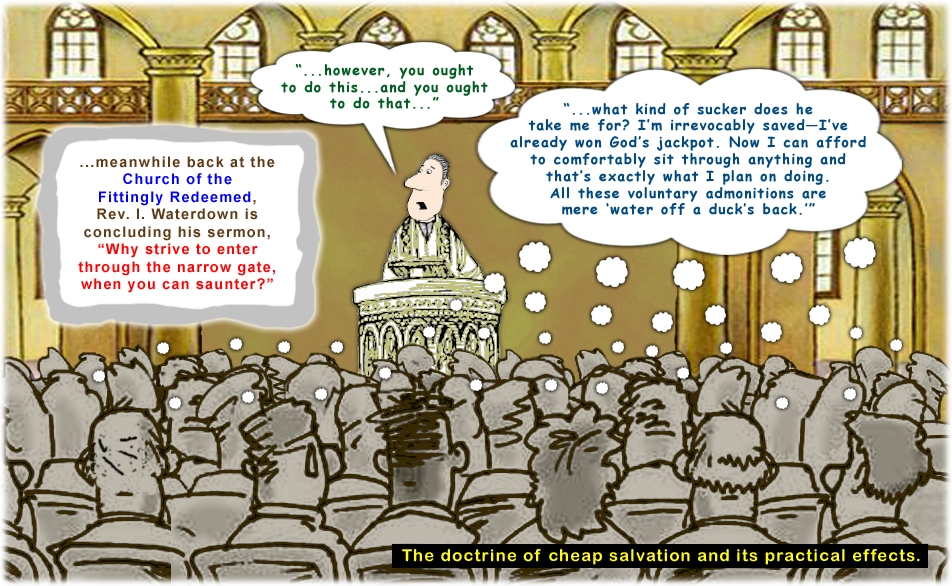
5. One might note that I placed Christianity and Jesus in separate categories. For the most part, most Christians agree with the Muslims that Jesus’ stated way is too difficult. So they build communities, nationalities, theologies and philosophies that transform Jesus’ gospel into something more palatable. Perhaps they claim that his salvation is simply “going to heaven” instead of being resurrected into the kingdom of God. Perhaps they see the means of salvation as “easy believism” or simple acceptance of a church’s teachings instead of Jesus’ way of life. But this is the reason that Jesus said—and continues to say—that the way to life is narrow, despite that there are more Christians in the world today than any other belief system. Because, ultimately, even Christians have a hard time believing what Jesus said.

What is the answer?
If you are looking for the salvation that Jesus’ offers—
An escape from karma through God’s grace
The Holy Spirit—God himself—to assist current living
A good life in God’s kingdom
-- Then Jesus is the only means to obtain that salvation.

If you want something else—
A good life in the here-and-now;
A way of escaping reincarnation;
A general spirituality without a real life in God
-- Then perhaps Jesus isn’t the one you are looking for.

Friday, January 28, 2011

Jesus' Answer to Original Sin

Continuing from the previous post, Original Sin

Thus does Jesus divide the entire world between the merciful and the judgmental. There is way, Jesus says, to get out of Adam’s system of judgmentalism, but it only happens by resting on God’s mercy. God is the author of mercy, and this mercy comes from His own nature. Thus, if we are to learn mercy, we must rest in God’s nature. How is this done? After all, we are all stuck in a system of rules and judgmentalism? It happens through the work of Jesus.

1. Jesus taught us what the problem is
Jesus came to earth first to inform us of the problem. Every system, especially the system that was supposed to represent God, ended up becoming long lists of rules that ended up condemning everyone. Jesus wasn’t antinomian—He wasn’t trying to say that we should do away with rules as a principle. Rather, He said that every rule should be based on the principle of love—the principle of acting for the benefit of others and all. Jesus said that any rule that stands against love is a rule that is begging to be broken and that one cannot hold the ones who break such a rule cannot be held guilty. Jesus taught us that religious systems created by people who invent rules and claim they are God’s rules is demon-possessed and must be delivered. Or it must be scrapped to allow a new system to be created.

2. Jesus told us to repent
Jesus said “Repent for the kingdom of God is near.” But this repentance wasn’t primarily about the petty sins we commit against our religious system or against our own sense of ethics. Rather, Jesus clarified that we needed to repent of our lack of mercy, we needed to repent of imposing ourselves on others, we needed to repent of seeing other people as extensions of ourselves, ways to meet our own needs and desires. He also told us that if we did not repent, that we could not enter into God’s kingdom, where we could actually and finally have all of our needs met.

3. Jesus died to create a new system
We were then in a quandary. Jesus taught us that our natural desires—to force others to participate in our system of false morality—and the systems in which we lived—which create a lifestyle of morality for everyone to fit into—are false and lead us not just away from God’s kingdom, but to hell. How can we change everything we have been taught, and how can we live separately from the world in which we live?

Jesus told us not just what we are to do, but he created the means by which we could do so. Jesus died to create the kingdom of God. This death, first of all, showed the utter failure of the system of the world. Both the system created around worship of the one true God (the Jewish cult) and the ultimate system of human organization (the Roman government) condemned Jesus—the representation of God’s mercy— and sent him to death. Thus did God declare these systems—and every human system—inadequate for accomplishing God’s will on earth.

And thus did Jesus open up the way for a new kingdom, the kingdom ruled by God and His mercy. Jesus chose people who would live their lives like Jesus did—surrendering everything so they could be God’s representatives of mercy to the world. And those few people were the mustard seed from which God would grow a mighty tree. The new system of God wouldn’t be like the old system. It couldn’t ever be contained by human organizations or policies. Every time the kingdom gets locked up by rules and traditions, God breaks it and establishes a new system which is based on His love and mercy.

4. Jesus gives the Spirit to create new creatures
Finally, in picking people to represent His mercy, Jesus did one more essential thing. If the new kingdom of God is to be run by people who acted only for the benefit of others, then something had to be done about their hearts. Because the human heart is born selfish and it is trained in selfishness. So Jesus gives every one who enters into His kingdom a new heart by the Holy Spirit. The Holy Spirit works within our selfish hearts and helps us to see other people. He gives us hearts of mercy, of compassion and He gives us wisdom so that we can know not only what others’ need, but also how to meet that need.

This is the secret of how we know who is really a part of God’s people or not. Not whether they have prayed a certain prayer, belong to a certain church or whether they are sufficiently religious enough. Rather, we know who, among all of those who claim Jesus, are the ones who are truly a part of God’s kingdom. These are the ones who have hearts of mercy and reject judgmentalism. Those who open their hearts to the poor. Those who see the need instead of the sin. Those who work at loving people instead of hating them. Anyone can claim Jesus. Anyone can say they are a child of God. The ones of the true faith, however, are the ones who display that the Spirit of love and mercy is working within them, making them new creations of gentleness and compassion.

The kingdom of God is still growing. And many of our religious systems must still be broken. When our rules cast people out instead of trying to meet their needs… when our attitudes are about rejection instead of expressing hope for someone’s future… when we refuse to be flexible to assist those in need… then it is time for God’s revolution to occur again. It is time for our systems of religion to be broken and for Jesus’ Spirit of love and mercy to open up a new people. Perhaps this new people will emerge from within the old system. Perhaps the system is so broken that the new people can only grow from without this system. But Jesus’ mercy and love can only exist in opposition to the natural order of things.

Wednesday, January 19, 2011

The Great Debate


This funny is to give the previous post some space so you can see that pic.

But since the subject was raised, let me talk a bit about the determinism/free will debate.

God is sovereign. But what does "sovereign" mean? It means that God is the king, the Lord of all the universe. There is nothing over which God does not rule. The question in the determinism debate, it seems to me, is: Does God micromanage?

The idea of micromanaging is if, in giving someone else authority over an area, do you follow that "giving" by determining all the specifics of how it should be run?

God clearly gave authority to others to rule over sections of His creation. "He gave the sun to rule the day and the moon to rule the night." Thus, those arenas of authority God handed over to those powers to rule. And the earth God handed over to humanity. Not only is humanity supposed to rule over the creatures of the earth, but humanity is to "subdue" the whole earth. The earth isn't just for us to enjoy and use, but to rule. (Genesis 1, 2, Psalm 8)

So when God gave the earth to humanity to rule, is God constantly controlling everything? It says that certain things were determined beforehand, before the foundation of the world. What is determined from the foundation of the world?

-Jesus was known (I Peter 1:20)
-Jesus was loved by the Father (John 17:24)
-A kingdom for merciful humans was founded (Matt. 25:34)
-The Father choses a people for himself (Eph. 1:4)
-The Father predestined a people who were adopted by Him (Eph. 1:5,11)
-There are names written in the Lambs Book, and these do not worship the Beast (Rev. 13:8; Rev. 17:8-- although it seems that some names can be taken out of the book Psalm 69:28 and Rev. 3:5)
-A certain people were determined to conform to Jesus' image. Then God acts on that determination to make it happen. (Romans 8:29)

What does this mean? That God's chosen people were chosen before the foundation of the earth. Does this mean that God chose each one individually? Revelation almost sounds that way because of the determination of "names" (although the erasing of some names out of the book gives one pause). But all of them could be that God determined the people, the nation, and the means of salvation (as it hints in I Cor 2:7), but not necessarily the specific individuals. It seems that God had a plan, from the foundations of the world, to deliver humanity and He has been working on that plan, especially through the coming, death and resurrection of His Son.

But has God been a micromanager? I don't think so. I don't think He's been going behind humanity, controlling every aspect of that which He gave over freely. Yes, He has made the occasional changes, as any manager would do, and He makes evaluations of how each division manager has done (not so good, so far-- Psalm 82).

It seems that God has limited his own sovereignty, according to His own word. When He delegates, that delegation is firm. Even when he destroyed "all" of humanity, he kept a remnant, so that His promise would not be made null and void.

But the real problem with the questions that Calvinists and Armenians discuss is that they are really beside the point. The thing we should really focus on is having every aspect of our lives put under the Lordship of Jesus. We may think it is determined ahead of time or it is our own choice, but it doesn't really matter. Those who submit to Jesus, those who are conformed to His image, those are the ones who are chosen. Thus, whether it is by destiny or by choice, it is our goal, our destiny.

Monday, January 17, 2011

How To Be Saved Though Christian


We are saved by grace, through faith. But what is the faith that Jesus described? Was it a single prayer? An intellectual belief? A social community?

Salvation in Jesus is not just an event, it is a life. Praise God that at a certain time in your life you presented yourself before Jesus and, in faith, accepted him. And you have assurance that he has accepted you as well, through the death of Jesus. But when Jesus, your Lord, spoke about salvation, he was not talking about a one time event. Rather, he spoke about a way, a path that somebody walks on, not just a stand that someone makes. He spoke about abiding in his word, not just believing in it. He spoke about enduring to the end, not just dedicating oneself. Even so, if you are to gain salvation on the last day, your faith must be something that is lived out every day.

Jesus describes the daily living of faith in this way: “If anyone would come after me, let him deny himself and take up his cross daily and follow me.” What does it mean to follow Jesus? What does it mean to take up the cross? Jesus spoke of seven things:

1. Be wholly, single-mindedly devoted to God alone.
No one can do slave-service to two masters. Either he will hate the one and love the other or he will be devoted to the one and despise the other. No one can serve both God and wealth. Matthew 6:24
If your eye causes you to stumble, throw it out; it is better for you to enter the kingdom of God with one eye, than, having two eyes, to be cast into hell, where their worm does not die and the fire is not quenched. Mark 9:47-48
Be rid of anything that distracts you away from God. This could be a pursuit of wealth, an abundance of possessions in your home, a certain standard of living, social obligations, friends or family that are trying to convince you to not fully commit yourself to God. It could be a drug habit, a sexual relationship, your CD collection, your television or your own pride or shame. Whatever it is, put it away from you and focus on following Jesus alone.
Actions of devotion:
Sell your possessions and give to the poor (Luke 12:33)
Separate yourself from family or friends that tempt you to fall away from the way of Jesus. (Luke 14:26-27)
Make a plan on how you can devote your whole life to God’s kingdom and righteousness with no distraction, take counsel with other believers, and DO IT! (Matthew 6:33)


2. Be obedient to God by doing what Jesus says.
Why do you call me, Lord, Lord and do not do what I say? Luke 6:46 Not everyone who says to me, "Lord, Lord" will enter into the kingdom of heaven, but he who does the will of my Father who is in heaven. Matthew 7:21
It is not enough to give lip service to Jesus, we must also obey him. We cannot call him “Lord” if we do not do what he says. We must study the teachings of Jesus and obey him in all our ways.
Actions of obedience:
Study the teachings and life of Jesus. (Luke 10:38-42)
Recognize that insulting another, looking lustfully at another, divorce, breaking your promise, not submitting to authorities (even evil ones), and only doing good to those who do good to you are sins that will condemn you. (Matthew 5:20-48)
Watch what we say, for out of our heart comes all sin. (Matthew 12:33-36)


3. Confidently take action to rely on God’s promises.
All things are possible to him who has faith. Mark 9:23
If we want to gain the blessings of God, then we must actively believe what God said he would grant those who have faith in him. It is not enough to intellectually “believe” in God’s promise—we must act on them! If Jesus is Lord—we must obey him! If the meek shall inherit the earth—we must be meek! If those who trust in God will have their needs met—we must trust in God for everything! It is not enough to talk about what we believe, we need to show that God’s promises will happen if we confidently step out to rely on them.
Actions of faith:
Pray for people to be healed and cast demons out. (Luke 10)
Be poor, mourn, be meek, cry out for justice, be a peacemaker, do mercy, be pure in heart, allow yourself to be persecuted for the sake of Jesus. (Matthew 3:3-12)
Pray for justice, for the Holy Spirit and for God’s kingdom to come. And don’t stop until they come! (Luke 18:1-8; Luke 11:1-11)
Rather than taking on vengeance yourself, wait for God to do it, for he will vindicate the innocent.


4. Boldly assert the word of Jesus in your life and proclaim it to others.
What I tell you in the darkness, speak in the light; and what you hear whispered in your ear, proclaim upon the housetops. Matthew 10:27
Jesus commands us to take his word and to give it to those who do not know it. This is an act of love, but it is also an act of sacrifice for we will often be rejected and even persecuted for announcing what Jesus says.
Actions of boldness:
Gently assert the words of Jesus to those who are acting in disobedience—whether non-Christian or Christian.
Radically re-shape your life into the image of the words of Jesus.


5. Sacrificially love everyone in need without exclusion.
But love your enemies, and do good, and lend, expecting nothing in return; and your reward will be great, and you will be sons of the Most High; for He Himself is kind to ungrateful and evil men. Be merciful, just as your Father is merciful. Luke 6:35-36
Jesus commands us to love everyone, without exclusion, even those people who hate us, or whom we find to be unlovely. Love means to love practically—not just with our heart. If we see someone in need, then we need to do all we can to meet that need—no matter who we are.
Sell your possessions and give to the poor. Luke 12:33
Our love is not just to be inclusive, but also sacrificial. Jesus gave of his whole self for our sakes and we are to do the same for those in need around us, especially for our brothers and sisters in Jesus
Actions of love:
Listen to people and find out their needs
Gently tell others when they are sinning before God.
Forgive everyone who repents of their sin.
Make available and give all that you have to those who are in greater need than you.
Do good to those who do evil to you—ask God to bless them, help them in times of need.
Feed the hungry, give clothes to those who don’t have enough, offer assistance to the needy—in what they need.


6. Humbly lower yourself under others.
Whoever wishes to become great among you shall be your servant; and whoever wishes to be first among you shall be slave of all. For even the Son of Man did not come to be served, but to serve, and to give His life a ransom for many. Mark 10:43-45
Jesus lowered himself before everyone and did the task that no one wanted to do—to face the shame and agony of dying for the world. We are to do the same kinds of actions. Jesus tells us to lower ourselves and be servants of everyone in order to gain his kingdom.
For everyone who exalts themselves will be humbled, and those who humbles themselves will be exalted. Luke 14:11
The principle is the same for everyone. If you lower yourself—be downwardly mobile—then God will raise you up in due time. But if you try to lift yourself up, then God will crush you and send you to hell.
Actions of humility:
Do acts of service that others find distasteful.
Actively associate yourself with those who are socially unacceptable.
Put yourself in a lower position than is fit for your station in life.


7. Remain with the words of Jesus although you suffer for it.
Everyone who endures to the end will be saved. Mark 13:13
Again, it is not enough to commit ourselves to the way of Jesus. We have to live it. It is not enough to begin the life of Jesus, we have to endure with it and with him even though we suffer for it. Let us trust him enough that when we lose everything and everyone for his sake, we will keep with him through it all so we may have him eternally.
Actions of endurance:
Assert God’s promises although no one believes you.
Speak the words of Jesus although you are reviled for it.
Obey Jesus although people disdain you for it.

Monday, January 10, 2011

What It Means To Be A Follower of Jesus

I wrote earlier about what a Christian believes. But to be a follower of Jesus is a completely different task. It is not a matter of intellectual assent or understanding the right facts. Rather, to be a follower of Jesus is a lifestyle, a commitment, an undertaking. And it is this that saves one, not whether one believes in this or that creation theory or atonement theory.

Some Christians will disagree with me— heck, MOST of them will dislike at least a portion of my presentation here. This is why I count myself as only nominally a Christian. I’m not a great Christian, because that’s not my goal. My goal is to be a follower of Jesus. And to be a follower of Jesus is, as I understand it, the following:

I am committed to Jesus as my Lord.
This isn’t just a belief, but a living reality by which I shape my life. Jesus is my King and my God, the one whom I obey, the one on whom I rely, the only one who I believe in without question. Jesus uses the Bible, and so do I, but if Jesus says something that a part of the Bible disagrees with, I hold to what Jesus says. Because it is Jesus, not Moses, not David who is my Lord. If society around me holds to something that Jesus disagrees with, then I stand with Jesus, because it is Jesus, not the government, not my friends, not my church who is my Lord.

I trust in the God who is merciful and powerful
The God and Father of Jesus is not an angry God, but a God who is sad that his creatures took the freedom and powers He gave them and squandered them. God wants all people and the rest of creation to live in harmony and justice. This will only be accomplished by God’s unlimited mercy and power, because humanity’s power, although sufficient, is too focused on short term, selfish ends. I also believe that God’s power acts to fulfill the needs of the poor and will help my deepest needs whenever I trust Him enough to cry out to Him.

I believe that Jesus died and rose from the dead due to my sins to create God’s perfect kingdom
I believe Jesus was a utopist. He was all about creating, living in and ruling God’s utopia. And while my sin—and the sins of all of God’s people—drove him to the cross, he did this to create a new people, a new government and a new law. In this new law, my repentance and confession offers me absolution. And I have the opportunity and responsibility to offer that absolution to others who, in Jesus’ kingdom, enact repentance and confession. This new kingdom is based on God’s mercy and power, and so is about changing the whole world to be as merciful, forgiving and assisting to the poor as God is.

Jesus’ power to change the world by the Spirit is in me
I have the power of prayer, which isn’t about words, but about the radical change of reality. The Spirit isn’t ethereal, but changes the world we live in for good. And I, when submitting to Jesus by faith, have the power to enact that power on those who will receive it.
Jesus’ insane morality is my own

Jesus’ life and death is mine to follow by example. As Jesus surrendered his privileged status, loved his enemies, hung out with sinners, gave to the poor, healed the sick, welcomed the outcast, rejected hypocrisy, was a thorn in the side to the religious establishment, accepted persecution, and did whatever crazy thing God told him to do, it is my responsibility that this outline will also describe my own life. This will not necessarily make me popular, and I’m okay with that.

I Expect A Great Life, but Not Yet
I am not living for this life, but for the next one. So my life may be filled with discomfort, rejection, poor health, and poverty for now, but I fully expect God to make this up to me. Because I have sacrificed my life for His, I expect a second chance, granted me by His own power. And in that second chance, Jesus tells me I will rule with Him on earth, in a body like His new body, assisting Him to bring peace, justice and mercy to both earth and heaven.

Thursday, October 7, 2010

The Manner V. the Meaning of Death

Tough Questions for Christians #35—The “Ultimate” Sacrifice
Watch It Here.

AZ asks why the thief who didn’t accept Jesus, who suffered the same as Jesus, but is still in hell, didn’t actually sacrifice more than Jesus. Why should Jesus be praised when basically he had a weekend in hell, but this guy has got all eternity?

Because the robber’s death didn’t do anything. His death was for a crime he had done (not stealing, by the way, but rebellion against the Romans), and so he was guilty. Jesus’ resurrection shows that he was innocent. It also shows that Jesus established a new kingdom. It wasn’t going to Sheol (not hell) that made Jesus special. It is the fact that he sacrificed himself in order to give the rest of us a second chance with God. The thief’s death didn’t do that. Sure, he suffered more. But the amount of suffering isn’t the point. It is what the suffering accomplishes. Jesus’ suffering accomplished more than we could imagine.

Monday, October 4, 2010

Justifying the Wicked

Tough Question for Christians #33—Christianity is an Abomination
Watch it here.

AZ is being pretty sneaky in this video, trying to get in two questions. His first question is a general complaint about God’s justice in condemning, even killing, an innocent man so that others can go free. I agree with AZ that this is unjust, but I explain in detail in my atonement blogs that this concept of atonement is only one idea of Christian atonement, and it is historically recent in the whole of Christian theology. I just don’t think it’s true. Rather, as I’ve said, I believe that Jesus was condemned by the Jews to show that every human system of justice, every human government is inadequate and that it rejects and kills the just and innocent, and then God established Jesus as the “First Citizen” of the Kingdom of God with its own law, it’s own system of forgiveness and it’s own merciful justice. And it is this kingdom that will rule the whole world.

AZ’s second question is his main point in this video, and in this he quotes Proverbs 17:15—“He who justifies the wicked and he who condemns the righteous, Both of them alike are an abomination to the LORD.” Yet, AZ says, the whole point of Christianity is to justify the wicked. Does this mean that, biblically, Christianity is an abomination?

On the one hand, I can easily say that Jesus was fully condemned by the Law and thus made a curse. Part of that condemnation is seeking justification for the wicked.

However, I think specifically for Proverbs, we need to look at the general context. The point of Proverbs is to have a pithy saying which communicates a truth. However, since each saying is brief, we have to look carefully in a broader context to understand the more nuanced truth. First of all, if what AZ is saying is correct, it means that the very idea of forgiveness of sin is an abomination. This is hard to accept, since forgiveness is a central characteristic of God in many places in the OT. No, God doesn’t forgive everyone, but it says in Ezekiel 18 that God is ready to forgive anyone who repents. Jesus says the same as does many others in the NT.

So what does this mean? Even as I John and Hebrews 10 can both be misinterpreted to mean that anyone who sins is going to hell, the fact is the OT defines the “wicked” as the person who unrepentedly sins continually. But the person who repents of their sin is forgiven, and this is justice. Jesus, in creating a new kingdom, is simply creating a place where the wicked can have the opportunity to repent.

The Proverbs passage AZ is speaking of is saying that the wicked must be punished by a judge. The abomination is not in forgiveness of the repentant, but in forsaking punishment for one who continues in their sin.

Tuesday, September 28, 2010

Is Adam Stronger Than God?

Tough Questions for Christians #30—Adam v. Jesus
Watch It Here

AZ’s question is pretty complicated this time, so let me try to simplify it. Adam, though his one action, caused the downfall of all humanity—we all sin because Adam sinned. Jesus, on the other hand, saves some of humanity through his sacrifice. But Adam was a finite human and Jesus is divine. How can it be that Adam’s action is stronger than Jesus’?

This is a pretty insightful question. Just as a sidenote, I just want to say that I appreciate AZ’s work. Most critics of Christianity have such a sparse concept of Christian theology that it is easy to dispute with what the theology actually is. AZ has a clear idea of Christian theology (most of the time) and then takes the theology to its logical next step. This is helpful and smart. This is a great service to the Christian church. So I want to just give a ‘thank you’ to AZ for his hard work for our benefit. It’s too bad he seems so bitter against the church that he can’t hear the real answers.

Back to the question. The basic problem is that Adam is father of all humanity, so he had a head start. Again, God gave humanity the opportunity to rule the world as they pleased and He refuses to take that away from them. Adam took that opportunity and led himself and his children away from listening to God’s wisdom. We are not sinners born. I believe we are primarily sinners taught. Taught by society and by example to do as we please, except where we displease our human authorities. We are not taught to love, we are not taught to do justice, except the most rudimentary kind. And if we do learn justice, we quickly learn that justice doesn’t exist in the adult, “real” world. So whatever expectations we had, they are soon taken away from us. Adam’s way, his leadership style, is the norm.

Jesus is the one leading us to go against the grain. To act out in mercy, no matter what the consequences. To be just, no matter what the consequences. To listen to God and ignore all other counsel. To love God with all my heart, no matter what else is tempting me to stray. This is true rebellion, to act in this way.

And humanity, for the most part, is a traditional society. We exist in entropy. That which was is what is and what will be. Jesus’ truth is not just a story. It’s about a new life. And this new life is not traditional—not even among the church.

This week I have been butting my head against Adam’s traditionalism. Others and I are struggling as to the proper use of a church facility. I want to use it for the poor, the immigrants, for peace in the community. But another church leader is saying that that path is too legally dangerous, too full of liabilities. That is the way of fear, the way of self-service, the way of retaining that which was built even though it is doing no one any benefit. The way of Jesus is radical mercy. It is having the courage to face death, persecution and yes, even court and insurance companies, for the sake of doing benefit for those who truly need it.

If we persist in fear, we are in the way of Adam. But it is only natural to do this. That’s the way of the world. Jesus’ way, although divine and divinely powered is ultimately too scary for the majority of humanity.