Monday, April 6, 2015

Obey: A Four Letter Word

My friend Styx and I were driving in the snow, just leaving a store where we picked up some food for the homeless folks in our church, keeping folks safe and warm and fed another day.  Yep, we are good people, and we don’t care who knows it.

Suddenly, blue and red lights flash behind us, and we are being pulled over by a local officer.  I’m wondering what I could have done wrong... as far as I could see, everything was legal.  The officer comes up to the window and politely points out that my friend didn’t have his seat belt on.  Styx is in a rage, almost shaking, but he keeps it to himself as he gives his ID number.  When the officer walks away, he fumes, “Really?  Don’t they have anything else better to do?”  He is almost shaking in rage. 

After the officer comes back, he gives Styx a ticket and explains that he won’t have to pay anything if he takes a safety class. As we drive away, Styx says, “Let me know that this is no big deal.”  I assure him that it isn’t, but that doesn’t lessen his rage.

Let’s face it, none of us likes to get caught doing something wrong.  We especially don’t like it when a wrong is over-punished, like Styx getting a 350 dollar ticket when he forget to put a strap across his shoulder. Recently, I’ve been reading what the Bible has to say about the ten commandments, and many have been shocked at how frequently the death penalty is used for the smallest infraction of the laws.  Like the man picking up sticks on the Sabbath and he is stoned to death.

Sometimes obedience is a problem because we think particular laws are useless or pointless.  An oft-repeated law in the OT is the rejection of boiling a kid in its mother’s milk.  Who would have thought of  that?  And if a society is okay with eating meat, what’s wrong with that?  Some rabbis interpret it as a separation between meat and dairy, but that doesn’t seem to be the point to me.  What IS the point?  Why should we go out of our way to obey such an arbitrary command?

In the end, obeying a bunch of arbitrary commands seems downright silly or even immoral.  Keeping the Sabbath holy seems okay until we are telling kids not to play on the Sabbath, or going hungry because a crisis happened and we couldn’t prepare food ahead of time.  Few people know that in the same section of Scripture that places a taboo on incest and homosexuality is a taboo on having sex with one’s wife while she is on her period. I mean, the idea is kind of gross, but they are married, so who can complain?  And what harm is there in other sexual taboos?  Bestiality is a form of animal abuse, and pedophilia is child abuse, rape is violence, but other kinds of sexual taboos… really, where’s the harm?

In the end, many people want to label sins as “stuff we do to hurt other people” and “nobody’s business”.  Obedience depends on whether we are harming others or not.  If we are loving people, all is good.  Otherwise, we shouldn’t bother.  If a person uses drugs, no harm, no foul, unless they do actual harm to another, like steal or neglect their child.   Everything should be dependent on love.  If no one is harmed, the no one should complain.

Living with God
The funny thing about sin, though, is that it has more to do with our relationship with God than anything else.  The ten commandments and all the laws that follow under those ten categories have to do with a community living under the sight of God, in the presence of God.  They are laws that don’t necessarily say, “This is how we live together”, but more like “God’s house, God’s rules” whether they make sense to the people or not.  God’s people couldn’t eat shellfish not because it could make them sick, but because, in that context, it was “gross” to God.  God was displeased by it.  Just like in my house we don’t have alcohol on the property and no one drinks there.  It’s because we have some who struggle with alcoholism, and we don’t want to tempt them.  This doesn’t mean that people can’t drink in other houses.  Or that loving people don’t drink—I don’t believe that.  That’s just how we work it in my house.

Often there are things that disgust others that we have no problem with.  Our spouse might find eating meat horrifying, but we don’t have any problems with it.  It would make sense that we not eat met in our house, out of respect and love for our spouse, although we might occasionally sneak out and grab a hamburger when she’s not around.  As long as our relationship is honest and respectful, there’s nothing wrong with that.  But if we insisted that our spouse watch us eat meat, or participate in eating meat, or to have the smell of cooked meat in the house, we are forcing the one we love to share in that which is abhorrent to her.

When we join God, we are married to Him.  As soon as we begin living together, we begin negotiating our lives with Him.  He will insist that we change some aspects of our lives, and we agree because we love him so.  We don’t want to disgust Him, even if we see nothing wrong with it.  So we make terms of living together, and we work these terms out together.

The problem is that some people think that the terms they live with God must be replicated by everyone else, as if everyone’s marriage must come to the same terms.  But how can we determine another’s relationship?  If we do not participate in a relationship, what right do we have to tell them how it should work?  Yes, we can look at another’s relationship and offer wisdom (if asked) about what might work or not.  But in the end, it is that couple, that pairing of God and that particular person, that must determine their own terms.  We might see how a couple might fail unless something changes, but in the end, that’s between them.

Learning to love
Let’s say that all “sin” or wrong-doing did have to do with harm to others and that all positive action has to do with loving others, including God.  Part of the problem we have with this is: What is real “harm” and what is only superficial?  What is really love?  And can’t something be loving in one context, but not another? Can’t something be loving in most contexts, but not all?

And how are we to know?  Let’s say that we have a toddler who only wants to love.  He would give useless gifts to those around him.  Do little deeds that ultimately mean nothing.  Perhaps he would command people to do pointless tasks, because he thinks that’s really loving, even though it’s not. We find it cute, but the actions of a toddler don’t really add up to love, no matter how much he tries.

Even so, we are all toddlers.  We all fail to understand what is truly love.  This is what happened to the law.  So much added to it that the people failed to understand the basic point.  Many people today couch the idea of love in the context of economic terms, that if we do what is good for the economy, we are doing what is good for everyone. 

Sometimes I feel that Jesus is the grown up trying to explain things in simple terms so us toddlers to love could understand.  He lays it out very simply and starkly sometimes: “Do good to those who harm you.” “Sell your possessions and give to the poor.” “Deny yourself.” “You cannot worship both God and wealth.” “Do not commit adultery.” “Do mercy.”  We sometimes find excuses to not follow these straightforward commands. We make ourselves busy with what doesn’t matter, so we don’t have to obey.  But really, we are just acting like disobedient toddlers who don’t want to do what is good for all of us.

Some of us need laws
While I was sitting next to Styx, all I could think of was how I agreed with the seat belt laws.  When I was in high school, I wrote a five page report about the proof that seat belts save lives.  I included the chances of death without a seat belt and how much more likely it is for a person with a seat belt to not die in the case of an accident.   But that didn’t change my habit of not wearing a seat belt.  Just knowing what was right and good doesn’t change our habits.

What did change my habit was when my state made wearing a seat belt compulsory.  On the day it became law, I began to click it around me and I have never turned back.  I appreciate the law because it was a simple tool to help me save my life for the sake of my wife and my children.  I probably would never have done it myself, without the law in place.

Even so, I don’t think I would have learned compassion or sacrificial love without Jesus telling me to do it.  I had a couple people ask me how I am such a compassionate person, and I responded to them honestly (which isn’t always the best idea): “I’m not compassionate.  I don’t really care that much.  I help people because Jesus told me to.  Someone asks me for help and my first response is to say no because I’m too tired or too busy already or don’t feel that they really deserve it.  Then I am reminded that I do this work not because I want to do it, but because Jesus does.  I’m here to represent Jesus and even though I might not give to this person, Jesus would.  So I’ve got to do what Jesus says, even if it doesn’t make sense to me.”

Some people might call this a servant mentality.  Some people might think that I’m so obedience-minded that I’m not open to really loving people.  I might agree.  But obedience is the path God gave me to learn to love.  I wish I was naturally loving.  But at least I’m on the path.  Perhaps others can approach love more flexibly and open-mindedly.   But I’m on the path that works for me.


So I’d say don’t complain about God’s rules and laws.  Perhaps they are doing some people some good.  And remember, that Jesus also gave us a law not to judge others.  That very restriction could be the path of freedom to everyone.

Partnership

In the beginning, God created the heavens and the earth, and they are His because he made them and subdued them and established good for all creatures—clean water, clean air, good food and sufficient shelter for all.  He then created women and men in His image, and gave us this good creation: all the earth, all the creatures of the earth, the real of the air, the realm of the sea and the realm of the land.  God also gave us ourselves to rule.  He gave us this world to rule for good, not for ill, to sustain and to create the Good, for we were made in His image and we were to rule in His likeness.

Humanity soon decided, although morally we are as toddlers, to rule ourselves and the earth without God’s counsel or assistance.  This is not as it was intended by the Creator.  He and we were supposed to rule in partnership, we ruling and he advising and empowering.  In rejecting the Creator in the rule of the earth, we rejected Love, we rejected Justice and we rejected true Power.  Without the Creator, we became narrow-minded, established self-serving systems and those who understood the good were powerless to establish it.

When Jesus came, he demonstrated a life of true partnership with the Creator.  He lived out and taught the law of Love, which did not have so much as specific rules as the basic principle of living for the well-being of others.  Jesus established justice by inviting the Creator to breathe life into those who are dying.  And Jesus relied on the Creator to demonstrate that true power comes from Him—not from politics, not from medicine, not from education nor from religious ritual.  Rather, it is an ongoing relationship with the Father that justice and love and power arises from.

* * *

The church is but a shattered image of Jesus.  Some pursue a relationship with the Father, praising exuberantly, attempting to live out His will, seeking His truth, to the exclusion of all else.  These will spend hours a day in prayer or study or meditation, seeking the descent of heaven in their lives. They seek God to work in our world, believing that He alone can establish the Good.

 Others are working to establish God’s kingdom on earth.  They are loving all, creating places of peace, establishing justice, working with the needy and establishing the good.  They look to God to infuse them with Love and Truth, and they do the work for they believe that they are His hands and feet.

Both sides have forgotten the partnership.  There is a place for human work and a place for the Creator’s work.  The Creator guides us to acts of love.  Like Jesus, the Creator shows us the work we are to do and we step into it.  But we must pray to depend on the Creator’s power.  We recognize our weakness, but it is easy to rely on human power to establish “God’s work”. 

Yet Jesus didn’t rely on his own power.  He left his home and family.  He had no medical knowledge to heal, yet he healed.  He didn’t carry food with him to feed the thousands, yet he fed them. He didn’t have a degree in psychology to bring peace to the mad, yet he gave them peace.  He accomplished his work through his boldness to approach the most needy around them, to understand the work of God and to step into God’s power to create life.  Jesus had nothing but his compassion and his reliance.

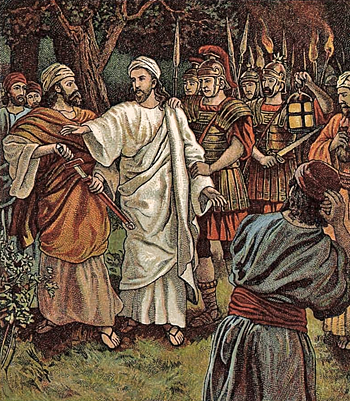
On the day of his arrest, Jesus saw the crowds coming, and he warned his disciples.  The disciples, having not prayed, only saw those who would separate them from their God.  They were the enemies, the hateful, the despised.  So they fought, then they retreated, then they scattered.  But Jesus, having prayed, was full of the love and power of God and saw people whose lives were on the edge.  So he healed, he comforted, he taught and he forgave.  He did not see enemies, he saw the needy.

Even so, God has put in our path the needy.  We know people whose lives hang in the balance.  They will die unless they have the touch of the Creator.  And we are to be Jesus to them.  We are not their Savior, rather, we are here to provide the way for them to touch the Savior.  We are to speak the word of love the Creator put in our mouths.  We are to touch them and pray for healing.  We are to ask them what they need. We are to speak the hard truth in gentleness. We are to feed the hungry.  We are to give shelter to the homeless. We are there to save lives.

But we are not to do this on our own.  We are not the Lifegiver.  We are not the Creator, but simply the mediator for the Creator.  We do not have energy to be there for everyone who is dying.  But the Creator does.  And He will give us the energy and power and love to create justice.  If…

If we would but pray and listen and work His work.  We need to pray because the work is not our own, but a partnership with the Creator and He gives us the power.  Without prayer, God does not act through us and our strength is insufficient to do the work.  We need to listen because in many ways we are still toddlers.  We deceive ourselves into thinking that our way is God’s way.  We listen to truly understand love.  And we need to work.  Without work, our prayer is simply words.  We pray and then we step in our prayers, embodying them, with God to give us the power.


Thus is the world subdued to peace.

What is Peace in the Bible?

Often when people talk about “peace” they think in terms of not having war.  That might be a form of national peace, but that is only a portion of what peace is in the Bible.  In the New Testament times “peace” was used as a term to mean what some politicians describe today—peace through warfare, through conquest and defeating enemies.  This stands in stark opposition to the peace of Jesus.

In the Bible, there are two main words used for “peace”.  One is “shalom”, the Hebrew word for peace in the Old Testament scriptures.  In the New Testament, the Greek word “erine” was used as a replacement for “shalom” but they really meant the same thing.  In both testaments it was commonly used as a greeting.  We might think that the greeting was simply a general way of saying, “Hey, I won’t kill you,” like shaking hands used to mean that no one was holding weapons.  But “shalom” meant more than that.

1.       Peace is personal and national
Just like today, the term “peace” in the Bible is used as a personal, individual characteristic, as well as a community or national one.  It is used as a characteristic for a church as well as being content with one’s lot.  It also is used to express a lack of conflict between two people.

2.       Peace means “complete well-being”
“Shalom” certainly stood for having a lack of conflict. But it also meant having one’s needs met, and not having anxiety.  It meant being of good health and having good relationships. 
Yet a little while and the wicked man will be no more; and you will look carefully for his place and he will not be there. But the humble will inherit the land and will delight themselves in abundant peace. Psalm 37:10-11

3.        Peace means both security and contentment
To have “shalom” was to be safe from harm.  But it also meant that one’s mind was at rest from oppressions, whether real or exaggerated.  To be at peace is to be free from both spiritual and inner demons.
Be anxious for nothing, but in everything by prayer and supplication with thanksgiving let your requests be made known to God. And the peace of God, which surpasses all comprehension, will guard your hearts and your minds in Christ Jesus. Philippians 4:6-7 

4.       Peace is reconciliation
Paul the apostle especially uses the term “peace” to speak of the reconciliation of all peoples under God.  It is the reconciliation of people with God and people with each other. This is the ending of false separations between races, sexes and religions, all unified under God through Jesus.

5.       Peace is unity
Christian peace is seen as unity between all followers of Jesus, forgiveness and holding others as more important than oneself.  Peace is love in community.
So, as those who have been chosen of God, holy and beloved, put on a heart of compassion, kindness, humility, gentleness and patience; bearing with one another, and forgiving each other, whoever has a complaint against anyone; just as the Lord forgave you, so also should you. Beyond all these things put on love, which is the perfect bond of unity. Let the peace of Christ rule in your hearts, to which indeed you were called in one body.  Colossians 3:12-15

6.       Peace is often seen as an agreement or covenant
Peace is sometimes established by a covenant, like a peace treaty.   Covenants, or permanent agreements between people, are tools for peace.  So when Jesus established his “new covenant” is was a peace treaty.
They said, "We see plainly that the LORD has been with you; so we said, 'Let there now be an oath between us, even between you and us, and let us make a covenant with you, that you will do us no harm, just as we have not touched you and have done to you nothing but good and have sent you away in peace. You are now the blessed of the LORD.'"  Genesis 26:28-29

7.       Peace comes from God
To truly be at peace is to receive peace from God.  The Bible doesn’t deny that there are other places to obtain peace, but that such peace is temporary and sometimes false.  God is the only source of peace that is complete and permanent.
Peace I leave with you; My peace I give to you; not as the world gives do I give to you.  John 14:27

What is peacemaking?
Thus, when Jesus speaks of his people being “peace-makers”, he is saying not so much that they stop wars, but that they bring peace to all relationships, to communities at large.  That they mend relationships, and create unity in Jesus.  They meet human needs and so create whole communities. 

Depart from evil and do good; Seek peace and pursue it. Psalm 34:14

Walls

Scholars of Mosaic law note that the sets of laws are often grouped according to the ten commandments.  That there are laws about proper worship, and then laws about roles.  There are laws about killings and laws about sexual mores and laws about justice.  But sometimes you get groups of laws that don’t seem to be connected at all, like in Deuteronomy 22:

A woman shall not wear man's clothing, nor shall a man put on a woman's clothing; for whoever does these things is an abomination to the LORD your God.
If you happen to come upon a bird's nest along the way, in any tree or on the ground, with young ones or eggs, and the mother sitting on the young or on the eggs, you shall not take the mother with the young; you shall certainly let the mother go, but the young you may take for yourself, in order that it may be well with you and that you may prolong your days.
When you build a new house, you shall make a parapet for your roof, so that you will not bring bloodguilt on your house if anyone falls from it.
You shall not sow your vineyard with two kinds of seed, or all the produce of the seed which you have sown and the increase of the vineyard will become defiled.
 You shall not plow with an ox and a donkey together.
 You shall not wear a material mixed of wool and linen together.
 Deut. 22:5-11 (New American Standard)

These laws just seem completely random.  But they aren’t.  In fact, the connection between not wearing another sex’s clothes and having a parapet on the roof gets to a deep theme in the Old Testament.  All of these laws have to do with setting proper boundaries.  That God created a natural order to things, and that things separated should not be mixed.  It is obvious that a roof on which people work and sleep (which they did in the ancient world, and in many places in the world today) should have a wall to protect people.  Even so, the OT claims that there needs to be walls placed between the sexes, walls placed between seeds, walls placed between species and walls placed between kinds of seeds, because mixing them brings disaster.  It is for this reason that there are food laws in the OT, and laws which declare that certain nations must be enculturated (perhaps up to 10 generations!) before they can be full citizens in Israel.  There must be an absolute border between Israelites and Canaanites, which is why the Canaanites were no longer supposed to exist as a race.  Some boarders cannot be crossed for any reason.

And yet when Jesus came on the scene, he seemed to have a different point of view.  The law that separated lepers and non-lepers, Jesus just ignored, touching lepers.  The laws that separated Jew and Gentiles, Jesus often ignored.  The laws that held men and women in different roles Jesus sometimes ignored (which is why Mary was allowed to have the male role of student, although Martha wanted her to take a more proper feminine role).  And what about Canaanites?

And a Canaanite woman from that region came out and began to cry out, saying, "Have mercy on me, Lord, Son of David; my daughter is cruelly demon-possessed." But He did not answer her a word. And His disciples came and implored Him, saying, "Send her away, because she keeps shouting at us." But He answered and said, "I was sent only to the lost sheep of the house of Israel." But she came and began to bow down before Him, saying, "Lord, help me!" And He answered and said, "It is not good to take the children's bread and throw it to the dogs." But she said, "Yes, Lord; but even the dogs feed on the crumbs which fall from their masters' table." Then Jesus said to her, "O woman, your faith is great; it shall be done for you as you wish." And her daughter was healed at once.  Matthew 15:22-28

At first, Jesus seems to be affirming the border of the Mosaic law—there is a firm distinction between Canaanite and Israelite, and they shall never pass.  In fact, Jesus calls her a dog.  But when she accepts this term, and claims that even dogs get crumbs, Jesus does a complete turnaround.  Why?  Because faith—trust and devotion to God—trumps all the other borders.  Borders mean nothing when there is faith and love.  In as much as the OT law affirms borders, Jesus breaks them.  Jesus insists that the very things that are separated by walls—male and female, Jew and Gentile, Moabite and Israelite, leper and healthy, sinner and saint—are no longer separated, but are, in fact, united by faith and love. 

And yet we have trouble with this even today.  We Christians want to re-establish borders because ultimately our love and faith isn’t strong enough to overcome our instinct to set up walls.  We want to distinguish Christian and non-Christian, homeless and housed, male and female, Jew and Palestinian, citizen and illegal immigrant, belonging to the right church group or the wrong one—all the very kinds of borders that Jesus did away with.  As quickly as Jesus takes down our walls and replaces them with love, we build new ones. 


We can either have walls, or we may have love.  We may either have borders or we may have a unity of faith.  

Your Salvation is Too Small

If your salvation includes forgiveness, but not healing, then your salvation is too small.
If your salvation includes heaven, but not a restored earth, then your salvation is too small.
If your salvation includes Christians, but not sinners, then your salvation is too small.
If your salvation includes freedom of worship, but not food, shelter and hope for the poor, then your salvation is too small.
If your salvation includes resurrection, but not the eradication of oppression, then your salvation is too small.

If your salvation includes reconciliation between God and man, but not reconciliation between enemies on earth, then your salvation is too small.
If your salvation includes a peaceful worshiping community, but not the destitute, then your salvation is too small. 
If your salvation includes purity, but not love, then your salvation is too small.
Think big


Your Kingdom Come

Once upon a time there was a kingdom of children, with a wise and celebrated leader.  The leader was a healer by trade and he brought these children from abusing families to be his children, and he cared for them with sweetness and gave them a wonderful home with all his vast resources at their disposal. 

At one point the children, still very young, decided that they were old enough and that they could take care of themselves.  The leader said, “You are still very young and need someone to guide you.  You can feed yourselves, but you can’t get along together.”  The children rose up in protest and anger and demanded that they be left alone to take care of themselves.  The leader said, “You are ultimately in charge.  If you want to leave my house and take care of yourselves, you can.  But I would rather you stayed in my house and lived with me and let me care for you.  I love you so.”  These words fell on deaf ears, and the children, as a group, decided to leave that night and rule themselves.

You could guess what happened.  The children, at first, were focused on surviving together and figuring out how to eat and build their shelters.  But soon little squabbles broke out.  Broken bones happened that weren’t healed correctly.  Some children wanted what they did not make, and if they were bigger, they took it.  More and more children got hurt, and everything was a mess. They chose some of the children to be in charge, to bring some order and stability, but all they did was cause more hurt.

But rather than think to themselves, “We should go back to our leader’s house” the children blamed the leader for all their troubles.  “The leader could heal my hurts, but he didn’t,” some would say.  “The leader said he loved us, but look at how miserable we are!”  “The leader could feed us better than this, but he abandoned us.”  “The leader is angry at us because of our misdeeds and so is causing us to suffer so.”

Of course, the leader never took his eyes off of them.  He loved them so, but he knew that they wouldn’t welcome him.  Finally, he couldn’t stand seeing them in their misery so he went and visited them.  Right away, he saw a child who was covered with sores and so he brought out a bottle of salve and made him feel better right away.  He saw another child who was irrational with anger and he spoke to him and calmed him and gave him peace.  He saw another child who was suffering with a broken bone that never healed, so he gave the child a local anesthetic, reset the bone and carefully wrapped it.  He saw two children fighting and he separated them, listened to them and loved them.

Soon many children flocked to him, realizing that he didn’t come to punish, but to love.  And he told them, “You all need to learn how to care for each other.  Take the effort you put in your anger, in your punishment of each other and put it into love.  Stop studying how to be in charge, and study how to help each other better. You have everything you need to care for everyone.”

The chosen rulers of the children could see their power slipping away, and that children would soon choose the leader to be in charge of them again, he was so kind and caring.  So they arrested the leader, beat him up to an inch of his life, and told him he had to leave.  He turned to the children and said, “I have to go.  But I will always be here.  Any of you can choose to have me as your leader again.  All you have to do is ask me, and I will guide you to love and care for each other.  Just call out my name, and I will be there to lead you.”  At this, the rulers of the children stabbed the leader, causing him to bleed, and he left.


Some of the children wondered if the leader was too weak to lead them.  Some of the children wondered if they should go to him, and try to find the house where they all once lived.  Many of the children said that the leader was just selfish and he was trying to trick them.  But many of the children listened to the leader, called out to him and he did lead them.  We aren’t sure how, but he did.  They would say, “Leader, your kingdom come.” Then he would come, secretly, and lead those children to love and to care for the other children, even if the other children didn’t deserve it.  And the world became a better place because the king came, if only for a little while.

This is a representation of Peter Abelard's soteriology.  I don't believe that it is a complete theology of salvation, but I do think it represents a better theology than substitutionary atonement. 

Five Timeless Heresies of the Church

For Reformation Day, when Martin Luther's 95 theses against the church mis-doctrine of indulgences are celebrated, I want to remind us of a few ways the church continues to misguide us all. 

1.       The church has the right to oppress heresies or immoralities
Heresies and immoralities come and go.  There will always be a sin that people call righteous and there will always be an evil doctrine that people call godly.  But the response of the true church to these is not to fight them or attack them.  The true church, in humility, realizes that neither our doctrine nor practice is perfect.  The true church will discuss, and point toward Jesus.  The true church realizes that Jesus alone is the true teacher and that Jesus is the only judge.  Thus, we do not judge for ourselves, nor teach our own doctrine or practice, but just point to Jesus.   And, like Jesus, we harm no one, nor let a hateful word pass our lips.

2.       The church is a place of safety from the world
We see our properties and buildings as holy places, a place of purity and quiet to worship the Lord.  To do that, we lock ourselves off from the chaos of the world, we separate ourselves from sinners and we create peace for those who live according to the tenants of our community.  But Jesus lived among the demon-possessed, the lepers and the chronically ill, in order to bring healing.  Jesus ate and fellowshipped with sinners, making them family.  Jesus offered peace to those who have no peace in themselves.  The church is not to create safety for itself, but safety for those who truly need it—the vulnerable of the world.

3.       Church leadership is a means of gain
Many become pastors because it is a decent profession and they want to help people.  Many become pastors because they want to discuss theology and the Bible and make a living at it.  Some become church leaders because they see it as a means of avoiding poverty and even a means of power for them and their family.  But Jesus said that church leadership is not a means of power or gain, but rather a means of slavery.  True leadership in the church is lowliness, poverty and the acceptance of persecution.  Jesus’ true leaders are those who give and give and give until there is nothing left to give, who drain themselves in love.


4.       Money and influence is power for the church
Churches and church leaders often complain that there is not enough money to run their programs, that they need more volunteers, that they need to wield more influence on the world.  They want to change the world and build community and they see wealth and people and politics as the means to create true change.  But according to Jesus, true change happens through resurrection, and resurrection only happens through the cross.  True change occurs when we completely trust the Power that enacts change.  The greatest power in the world for change is trust in God, and we enact that trust by living according the merciful will of God.

5.       Oppression of the church is to be avoided

We pray for our persecuted brothers throughout the world, and we might seek political change to ease their suffering.  We are willing to fight and even bomb those who threaten the lives of our fellow Christians.  We will enact cultural war so we need not change our traditions and practices for any outside influence.  But Jesus said that we are not to fight persecution, but rejoice in it.  We are not to fear tribulation, but to recognize that it is the key to open the door to the kingdom of heaven.  It is a means of opening up the heavens so that blessings would come down upon us.  For when we have the comforts and support of this world, we will not obtain the greater blessings of God.  The oppressed church is the normative church.